
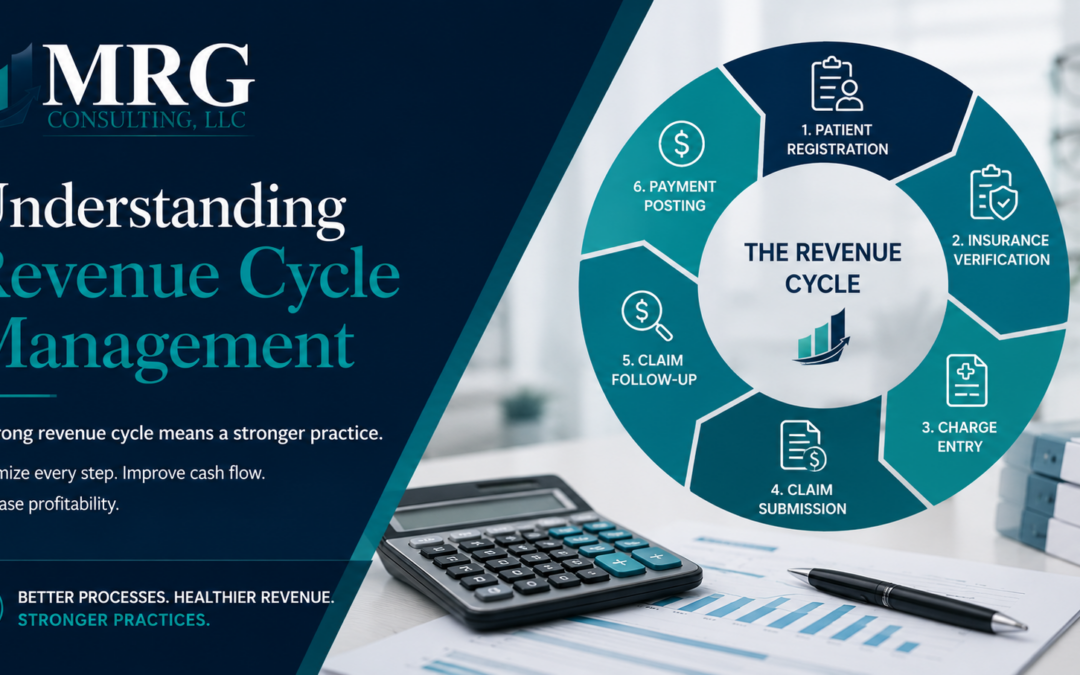
When practice owners hear the term “Revenue Cycle Management,” many immediately think about insurance billing and collections.
While billing is certainly an important part of the process, Revenue Cycle Management (RCM) encompasses much more. In fact, the revenue cycle begins long before a claim is submitted and continues until every dollar owed to the practice has been collected.
Understanding how the revenue cycle works—and where breakdowns occur—can have a significant impact on profitability, cash flow, and overall practice performance.
What Is Revenue Cycle Management?
Revenue Cycle Management is the process of tracking and managing patient revenue from the moment an appointment is scheduled until final payment is received.
The revenue cycle includes:
- Appointment scheduling
- Insurance verification
- Patient registration
- Clinical documentation
- Coding and charge entry
- Claim submission
- Payment posting
- Denial management
- Patient collections
- Financial reporting
Every step in the process influences the financial health of the practice.
The Revenue Cycle Starts at Scheduling
Many revenue problems begin before the patient ever arrives.
Incorrect patient information, outdated insurance records, and inadequate insurance verification can create delays, claim denials, and unnecessary administrative work.
A strong scheduling and verification process helps ensure:
- Accurate patient information
- Eligibility confirmation
- Reduced claim denials
- Improved patient experience
- Faster payment collection
The smoother the front end of the process, the more efficient the back end becomes.
Coding Accuracy Matters
Accurate coding is essential to ensuring the practice receives appropriate reimbursement for services provided.
Even small coding errors can result in:
- Delayed payments
- Claim denials
- Reduced reimbursement
- Increased administrative costs
Proper documentation and coding practices help protect revenue while supporting compliance and operational efficiency.
Managing Claims Effectively
Submitting a claim is not the same as collecting payment.
Many practices focus heavily on claim submission but spend insufficient time monitoring claim performance after submission.
Effective claim management includes:
- Tracking claim status
- Identifying denials
- Correcting errors promptly
- Following up on unpaid claims
- Monitoring reimbursement trends
The faster issues are identified and resolved, the faster revenue enters the practice.
Denial Management Is Critical
Denied claims represent one of the most common sources of revenue leakage.
Unfortunately, some denied claims are never corrected or resubmitted.
A consistent denial management process helps practices:
- Recover lost revenue
- Reduce write-offs
- Improve reimbursement rates
- Identify recurring issues
- Strengthen overall financial performance
Even modest improvements in denial management can produce significant financial benefits.
Patient Collections Matter Too
As patient responsibility continues to increase, collecting balances directly from patients has become a larger component of practice profitability.
Practices should have clear systems for:
- Communicating financial responsibility
- Collecting co-pays
- Managing balances
- Following up on outstanding accounts
Strong collection procedures improve cash flow while reducing aging accounts receivable.
Monitoring Key Performance Indicators
One of the most effective ways to improve revenue cycle performance is by measuring key metrics consistently.
Examples include:
- Days in Accounts Receivable
- Collection percentage
- Denial rates
- Net collection ratio
- Revenue per patient
- Insurance reimbursement trends
- Outstanding patient balances
These metrics help identify opportunities for improvement before they become larger financial challenges.
Revenue Cycle Management Is a Practice-Wide Responsibility
Many practices view Revenue Cycle Management as the responsibility of the billing department.
In reality, every team member contributes to revenue cycle success.
Front desk personnel, technicians, opticians, providers, managers, and billing staff all influence the accuracy, efficiency, and profitability of the process.
When the entire team understands its role, the practice operates more efficiently and financial performance improves.
Strong Revenue Cycles Build Strong Practices
The most profitable practices are not necessarily the busiest practices. They are often the practices that manage their revenue cycle most effectively.
By improving processes, reducing errors, strengthening collections, and monitoring performance, practice owners can increase profitability without increasing patient volume.
At MRG Consulting, we help optometric practices evaluate their revenue cycle, identify hidden inefficiencies, and implement practical solutions that improve cash flow, profitability, and long-term practice value.
Because every dollar earned should have the opportunity to reach the bottom line.