
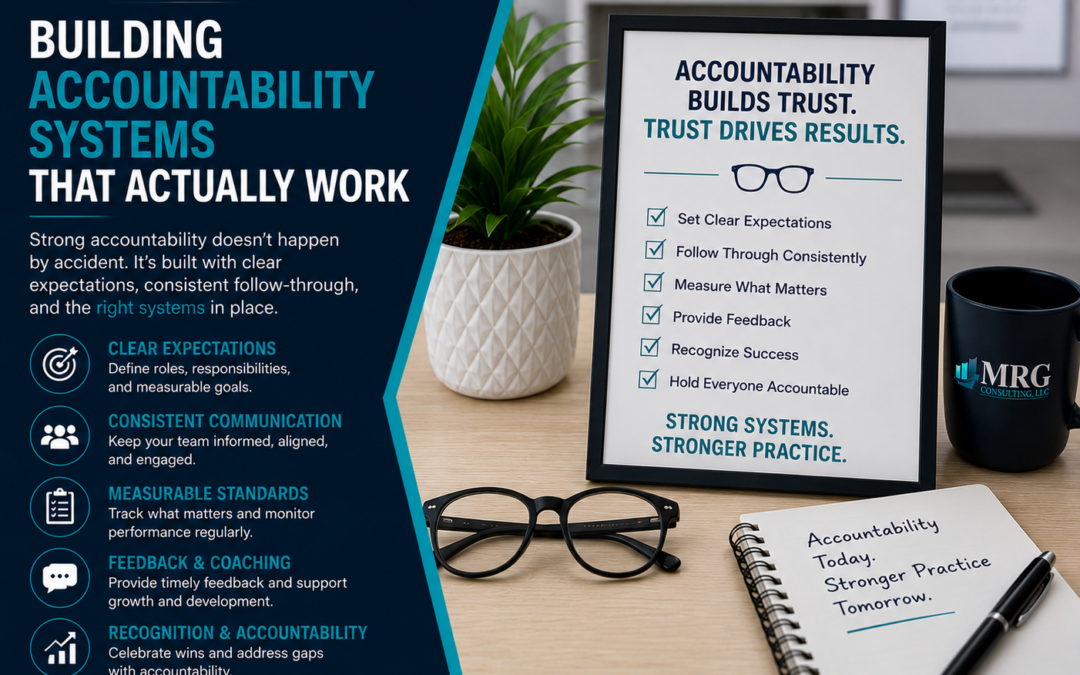
For many practice owners and managers, accountability is one of the most challenging aspects of leadership.
Employees may miss expectations, productivity may vary from person to person, and important tasks sometimes fall through the cracks. When these issues occur repeatedly, frustration grows, performance suffers, and profitability can decline.
Yet accountability is often misunderstood.
True accountability is not about discipline, criticism, or micromanagement. It is about creating clarity, consistency, and ownership throughout the organization.
When accountability systems are properly implemented, teams become stronger, communication improves, and performance naturally follows.
Why Accountability Matters
Every successful practice relies on people performing their responsibilities consistently.
Without accountability:
- Expectations become unclear
- Performance varies widely
- Team frustration increases
- Operational mistakes become more common
- Patient experiences suffer
Strong accountability systems create stability and help ensure everyone is working toward the same goals.
Accountability Begins With Clarity
One of the biggest mistakes leaders make is assuming employees know exactly what is expected of them.
In reality, many performance issues stem from unclear expectations.
Employees should understand:
- Their responsibilities
- Performance expectations
- Practice goals
- Key performance indicators (KPIs)
- How success is measured
When expectations are clearly defined, accountability becomes significantly easier.
Create Measurable Standards
Vague expectations produce vague results.
For example:
“Improve patient service.”
sounds good but lacks measurable standards.
A better approach might be:
- Maintain a patient satisfaction score above a specific benchmark
- Verify insurance information before every appointment
- Achieve a target optical capture rate
- Reduce appointment scheduling gaps
Clear, measurable expectations allow both employees and leaders to evaluate performance objectively.
Accountability Requires Consistency
Many practices establish policies but fail to enforce them consistently.
When accountability varies from employee to employee, trust begins to erode.
High-performing teams thrive when expectations apply equally across the organization.
Consistency creates:
- Fairness
- Trust
- Predictability
- Stronger workplace culture
Employees are far more likely to embrace accountability when they believe standards are applied fairly.
Regular Communication Is Essential
Accountability should never be reserved for annual performance reviews.
The most effective leaders provide ongoing feedback through:
- One-on-one meetings
- Team meetings
- Performance discussions
- Coaching conversations
Frequent communication allows small issues to be addressed before they become larger problems.
It also provides opportunities to recognize successes and reinforce positive behaviors.
Accountability Is Not Micromanagement
One reason many leaders avoid accountability is fear of appearing controlling.
However, accountability and micromanagement are not the same thing.
Micromanagement focuses on controlling every action.
Accountability focuses on achieving agreed-upon outcomes.
Strong leaders establish expectations, provide resources, monitor performance, and trust employees to execute their responsibilities.
This approach creates both ownership and confidence.
Recognition Is Part of Accountability
Many people associate accountability only with correcting mistakes.
In reality, recognition is equally important.
Employees who consistently meet or exceed expectations should receive acknowledgment for their contributions.
Recognition helps:
- Improve morale
- Increase engagement
- Reinforce desired behaviors
- Strengthen retention
People are more likely to repeat behaviors that are appreciated and rewarded.
Accountability Supports Growth
As practices grow, informal management becomes increasingly difficult.
Systems become essential.
Well-designed accountability systems help leaders:
- Manage larger teams
- Improve productivity
- Strengthen communication
- Increase profitability
- Deliver more consistent patient experiences
What works with three employees often fails with fifteen.
Growth requires structure.
Leadership Sets the Tone
Accountability starts at the top.
Employees are more likely to embrace accountability when leaders demonstrate it themselves.
Great leaders:
- Follow through on commitments
- Accept responsibility
- Communicate clearly
- Maintain consistency
- Lead by example
A culture of accountability begins with leadership behavior.
Accountability Creates Stronger Practices
The highest-performing practices do not succeed because they have perfect employees.
They succeed because they have clear expectations, strong leadership, consistent systems, and a culture where people take ownership of results.
At MRG Consulting, we help optometric practices develop accountability systems that improve communication, strengthen team performance, and create sustainable operational excellence.
Because accountability isn’t about creating pressure—it’s about creating clarity, ownership, and the foundation for long-term success.