
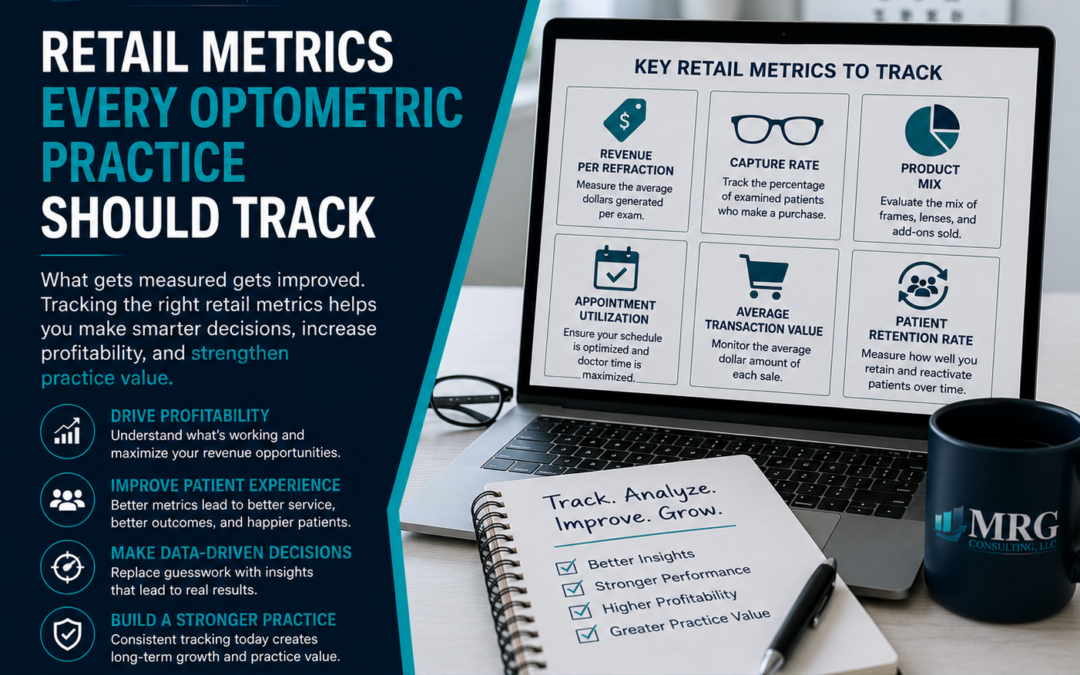
You cannot improve what you do not measure.
Many optometric practices focus heavily on patient care and day-to-day operations but spend surprisingly little time tracking the key performance indicators (KPIs) that drive profitability and growth.
The most successful practices use data to guide decisions, identify opportunities, and measure progress. They understand that metrics are not simply numbers on a report—they are tools that help leaders build stronger businesses.
Tracking the right metrics can provide valuable insight into the health of your practice and reveal opportunities that might otherwise go unnoticed.
Why Metrics Matter
Without reliable performance data, decisions are often based on assumptions rather than facts.
Metrics help practice owners:
- Identify trends
- Measure performance
- Improve profitability
- Strengthen accountability
- Make informed business decisions
- Support long-term growth
The goal is not to track every possible number. The goal is to focus on the metrics that have the greatest impact on practice success.
Capture Rate
Capture rate measures the percentage of patients who purchase eyewear from your practice after receiving an eye exam.
This is one of the most important indicators of optical performance.
A higher capture rate typically results in:
- Increased optical revenue
- Improved profitability
- Better inventory performance
- Stronger patient retention
Even small improvements can produce significant financial results.
Average Optical Sale
Average Optical Sale measures the average dollar amount spent per optical transaction.
This metric helps practices evaluate:
- Product mix
- Staff effectiveness
- Premium lens adoption
- Multiple pair sales
Practices that focus on increasing average optical sale often improve profitability without increasing patient volume.
Revenue Per Patient
Revenue Per Patient measures the average revenue generated by each patient encounter.
This metric provides valuable insight into:
- Service utilization
- Product sales
- Revenue opportunities
- Overall financial performance
Monitoring revenue per patient helps practices evaluate the effectiveness of both clinical and retail operations.
Inventory Turnover
Inventory turnover measures how quickly optical inventory is sold and replaced.
Healthy turnover typically indicates:
- Strong product selection
- Effective purchasing decisions
- Better cash flow management
Low turnover may suggest excess inventory, outdated products, or merchandising challenges.
Inventory that sits too long ties up capital and reduces profitability.
Gross Margin
Gross margin measures the profitability of products sold after accounting for cost of goods.
Monitoring margin helps practices:
- Evaluate pricing strategies
- Assess vendor relationships
- Improve purchasing decisions
- Increase profitability
Revenue growth alone does not guarantee stronger profits. Margin performance is equally important.
Multiple Pair Percentage
Many patients can benefit from multiple pairs of eyewear for different activities and lifestyles.
Tracking multiple pair sales helps practices measure:
- Patient education effectiveness
- Product recommendation success
- Revenue opportunities
Practices that successfully promote second-pair purchases often see meaningful improvements in optical profitability.
Schedule Utilization
Provider schedules represent one of the practice’s most valuable assets.
Schedule utilization measures how effectively appointment slots are being filled.
Strong utilization supports:
- Revenue growth
- Operational efficiency
- Better resource management
Unfilled appointment slots represent lost revenue opportunities that can never be recovered.
Patient Retention
Acquiring new patients is important, but retaining existing patients is often more profitable.
Retention metrics help practices evaluate:
- Patient satisfaction
- Recall effectiveness
- Long-term growth potential
Strong patient retention often reflects a positive patient experience and a healthy practice culture.
Staff Productivity Metrics
Every team member contributes to practice performance.
Tracking productivity metrics helps leaders evaluate:
- Efficiency
- Accountability
- Workflow effectiveness
- Training opportunities
The purpose is not to micromanage employees but to support growth and continuous improvement.
Focus on Trends, Not Individual Numbers
One common mistake is reacting to a single month’s performance.
Successful practices focus on trends over time.
Consistent monitoring allows leaders to:
- Identify emerging challenges
- Measure the impact of improvements
- Make better strategic decisions
The real value of metrics lies in understanding the story they tell.
Data Creates Better Decisions
The most profitable practices are not necessarily the busiest practices.
They are often the practices that understand their numbers and use them to guide decision-making.
At MRG Consulting, we help optometric practices identify the metrics that matter most, develop meaningful reporting systems, and use performance data to improve profitability, efficiency, and long-term growth.
Because when you measure the right things, you gain the ability to improve them.