
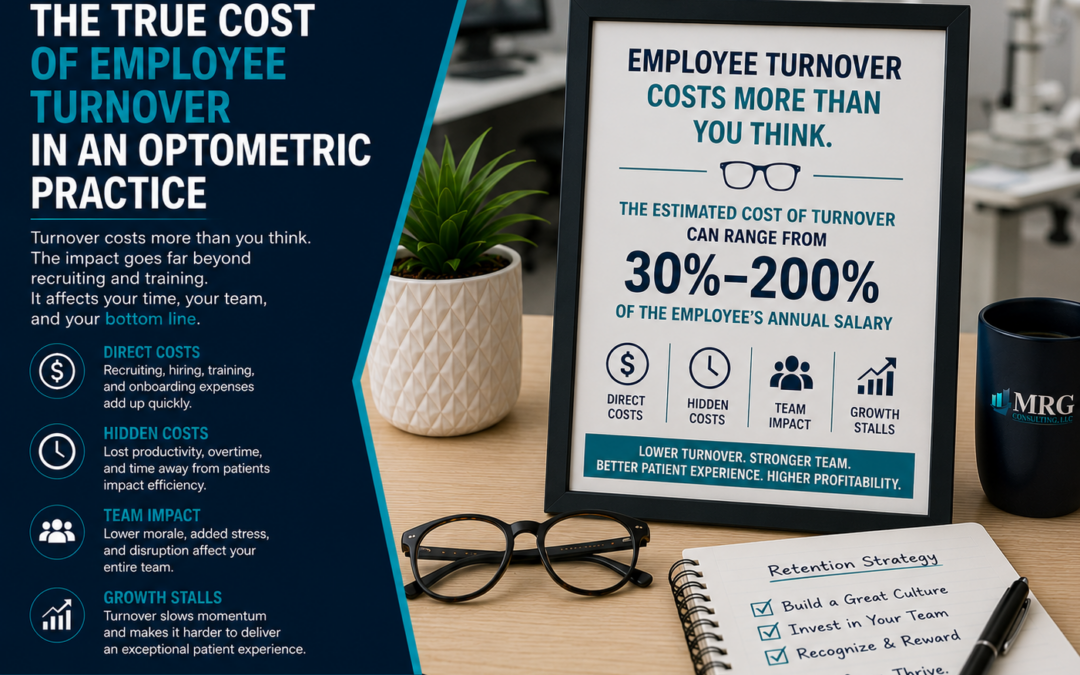
Most practice owners understand that employee turnover is frustrating. What many fail to realize is just how expensive it can be.
When a valued team member leaves, the cost extends far beyond recruiting and hiring a replacement. Turnover impacts productivity, patient experience, team morale, operational efficiency, and ultimately, profitability.
In today’s competitive labor market, retaining great employees has become one of the most important factors in building a successful optometric practice.
The Direct Costs of Turnover
The most obvious costs are those associated with replacing an employee.
These may include:
- Recruiting expenses
- Job advertisements
- Interview time
- Background checks
- Onboarding costs
- Training expenses
- Uniforms and equipment
While these costs can be significant, they often represent only a small portion of the total financial impact.
The Hidden Costs Are Often Greater
The true cost of turnover is frequently found in lost productivity.
When an experienced employee leaves, valuable knowledge leaves with them.
The replacement employee often requires weeks or months to fully develop the skills, confidence, and efficiency necessary to perform at the same level.
During this transition period, practices may experience:
- Slower patient flow
- Increased errors
- Reduced efficiency
- More management oversight
- Additional workload for existing staff
These hidden costs often exceed the direct costs of hiring and training.
The Impact on Patient Experience
Patients notice when teams are stable and well-coordinated.
They also notice when they are not.
Frequent staff turnover can lead to:
- Inconsistent patient experiences
- Longer wait times
- Communication breakdowns
- Reduced patient satisfaction
- Lower patient retention
In a profession built on relationships and trust, consistency matters.
Strong employee retention contributes directly to stronger patient loyalty.
Turnover Affects Team Morale
When employees leave frequently, remaining team members often feel the impact.
They may be asked to:
- Cover additional responsibilities
- Work longer hours
- Train new employees
- Manage increased workloads
Over time, this can lead to frustration, burnout, and additional turnover.
This creates a cycle that becomes increasingly difficult to break.
Why Employees Leave
Many practice owners assume employees leave primarily because of compensation.
While compensation is important, studies consistently show that employees often leave for other reasons, including:
- Lack of, and/or poor leadership
- Poor communication
- Limited growth opportunities
- Lack of recognition
- Inconsistent accountability
- Unclear / unfair expectations
In many cases, employees leave managers and workplace cultures more often than they leave jobs.
Building a Culture That Retains Talent
Successful practices understand that employee retention begins with leadership.
Strong leaders create environments where employees feel:
- Valued
- Supported
- Challenged
- Respected
- Accountable
Practices that invest in leadership development, communication, and employee growth often experience stronger retention and better performance.
Accountability Matters
One common mistake practices make is confusing accountability with discipline.
True accountability creates clarity.
Employees perform best when they understand:
- Their responsibilities
- Performance expectations
- Success metrics
- Growth opportunities
When expectations are clear and consistently reinforced, team performance improves and turnover often decreases.
Employee Development Drives Performance
People want opportunities to grow.
Practices that provide training, coaching, and professional development often experience:
- Higher employee engagement
- Improved productivity
- Better patient experiences
- Stronger retention rates
Developing employees is not simply an investment in people—it is an investment in practice performance.
Retention Is a Profitability Strategy
Many owners view employee retention as a human resources issue.
In reality, it is a business strategy.
Stable teams typically produce:
- Better patient experiences
- Higher productivity
- Improved efficiency
- Stronger profitability
- Greater practice value
Reducing turnover can have a meaningful impact on the financial health of the practice.
Great Teams Don’t Happen by Accident
Building and retaining a high-performing team requires intentional leadership, clear expectations, ongoing development, and a positive culture.
The most successful optometric practices recognize that their people are among their most valuable assets.
At MRG Consulting, we help practice owners develop stronger leadership systems, improve accountability, create positive workplace cultures, and build high-performing teams that support long-term success.
Because when you invest in your people, your people invest in your practice.