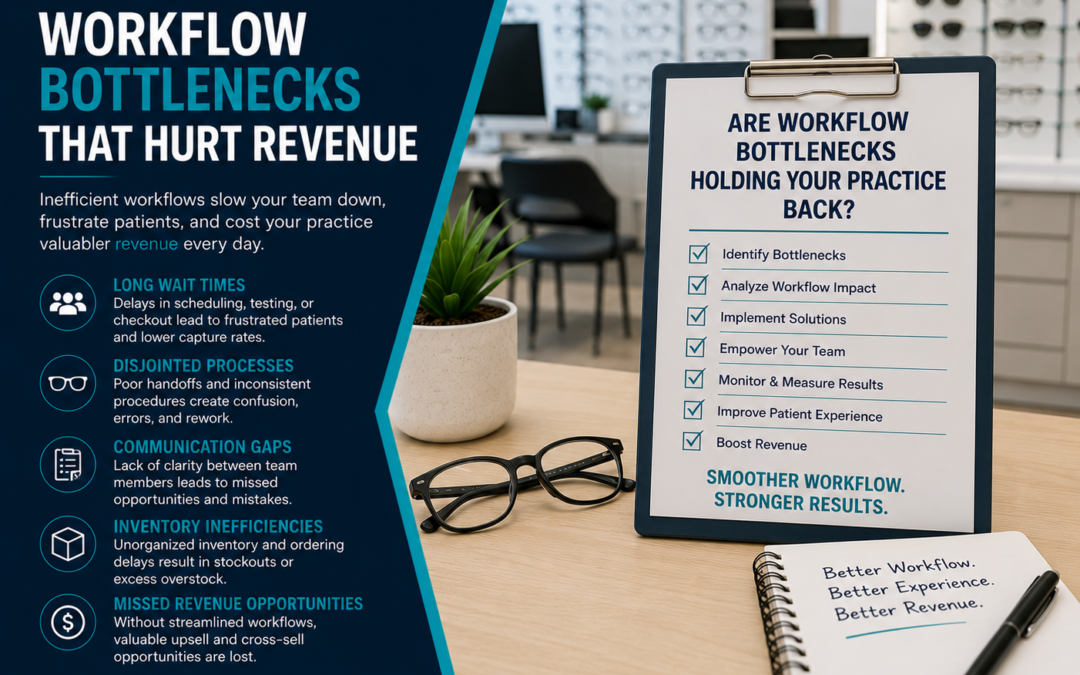
Most practice owners recognize workflow bottlenecks when they create frustration for patients or staff. What many fail to realize is that workflow inefficiencies often have a direct impact on revenue and profitability.
Every day, small delays, unnecessary steps, communication breakdowns, and inefficient processes quietly cost practices time and money.
While a single bottleneck may seem insignificant, the cumulative effect across hundreds or thousands of patient visits each year can be substantial.
Understanding and eliminating workflow bottlenecks is one of the most effective ways to improve both operational performance and financial results.
What Is a Workflow Bottleneck?
A workflow bottleneck occurs when one part of a process slows down or restricts the flow of work through the practice.
Think of it like traffic on a highway.
When multiple lanes merge into a single lane, traffic slows and delays occur. The same principle applies within an optometric practice.
When one area becomes overloaded or inefficient, the entire patient experience can suffer.
Scheduling Inefficiencies
One of the most common bottlenecks begins with scheduling.
Common scheduling issues include:
- Gaps in the schedule
- Excessive appointment clustering
- Inadequate appointment allocation
- Poor recall systems
- Inefficient rescheduling processes
These issues can result in lost revenue opportunities and underutilized provider time.
A well-managed schedule supports both patient satisfaction and profitability.
Insurance Verification Delays
Insurance verification may seem like a routine administrative task, but when performed inconsistently it can create significant disruptions.
Problems often include:
- Missing information
- Eligibility surprises
- Delayed patient check-in
- Claim denials
- Increased administrative workload
Proper verification processes reduce downstream problems and improve revenue cycle performance.
Patient Flow Challenges
Many practices experience bottlenecks between departments.
Examples include:
- Patients waiting excessively for technicians
- Delays between testing and provider examinations
- Incomplete documentation
- Communication breakdowns between team members
When patient flow slows, providers may see fewer patients and staff productivity declines.
Even small improvements in patient flow can significantly increase operational efficiency.
Optical Department Delays
The optical department often represents a major profit center, making workflow efficiency especially important.
Common bottlenecks include:
- Long wait times for frame selection
- Inconsistent handoffs from providers
- Inventory challenges
- Delayed order processing
- Lack of staffing during peak periods
These issues can negatively impact both capture rate and patient satisfaction.
When patients encounter friction during the purchasing process, sales opportunities are often lost.
Communication Breakdowns
Poor communication creates hidden inefficiencies throughout the practice.
Common examples include:
- Unclear responsibilities
- Inconsistent procedures
- Missing patient information
- Delayed follow-up
- Lack of accountability
These challenges often result in duplicate work, increased errors, and wasted time.
Strong communication systems improve efficiency and reduce costly mistakes.
Technology Isn’t Always the Solution
Many practices assume new software or technology will solve workflow issues.
While technology can certainly help, many bottlenecks stem from processes rather than systems.
Without proper workflows, even the best technology can become another source of frustration.
Successful practices evaluate both their technology and the processes surrounding it.
The Financial Impact of Workflow Bottlenecks
Workflow inefficiencies often lead to:
- Reduced patient capacity
- Increased overtime
- Lower staff productivity
- Higher labor costs
- Missed revenue opportunities
- Reduced patient satisfaction
Over time, these issues directly affect profitability.
The most efficient practices often achieve stronger financial performance without increasing patient volume simply because they make better use of their existing resources.
Continuous Improvement Matters
Operational excellence is not a one-time project.
As practices grow and evolve, workflows should be reviewed regularly.
Successful leaders continuously evaluate:
- Patient flow
- Staff productivity
- Scheduling efficiency
- Communication systems
- Operational performance
Small improvements made consistently over time often produce remarkable results.
Removing Bottlenecks Creates Growth
Many practice owners believe growth requires additional providers, more locations, or increased marketing.
In reality, significant growth opportunities often already exist within the practice.
By identifying and eliminating workflow bottlenecks, practices can improve efficiency, increase profitability, enhance patient experiences, and strengthen overall performance.
At MRG Consulting, we help optometric practices evaluate workflows, identify operational barriers, and implement practical solutions that support sustainable growth and long-term success.
Because every bottleneck removed creates new opportunities for performance, profitability, and patient satisfaction.